The Photo Box -- Chapter 47
The Alley Behind 1343 Wolfram Street

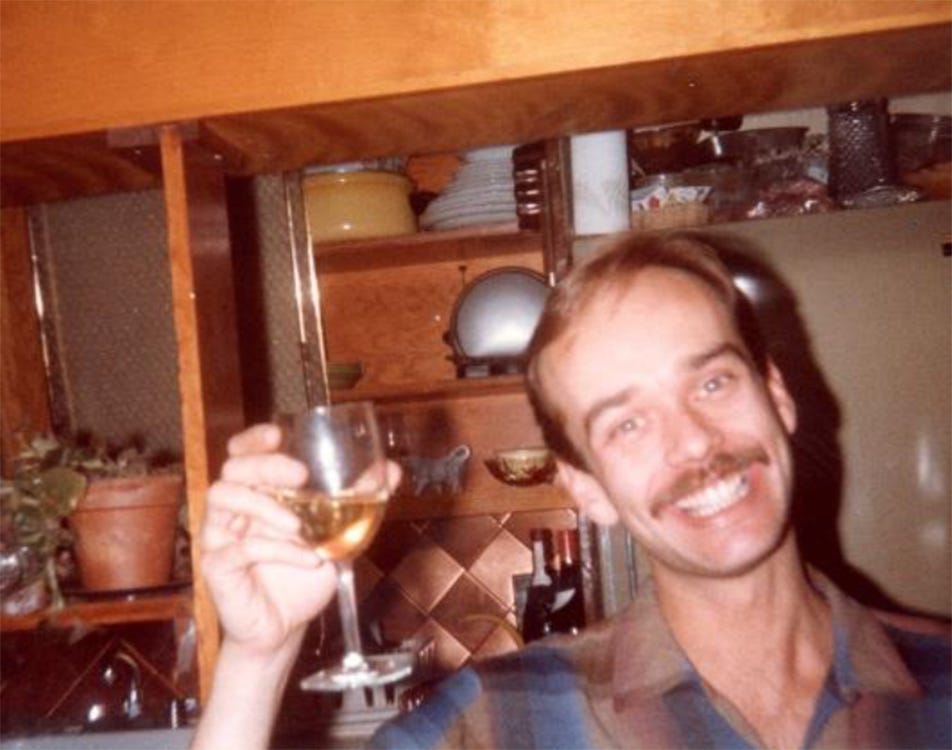
This apartment’s personality was such that it often made up for what I lacked, although, of all the places I lived in Chicago over 16 1/2 years, I like to think we were equally matched and that it was as much a personification of me as I was of it.
This was an apartment that was passed from one friend to another as the current tenant’s life took a turn and required their leaving it behind; all that was required was a “I’m moving,” and the word was out that it was available. It is how I came to live there after my fall from grace, and as I was reconstructing my life…perhaps even ‘finding myself’ to use the psycho-patois of the day. I was living with Toni—who had rescued me from my past. The apartment was passed lovingly, perhaps a little frayed around the edges, misty with the previous tenants’ memories still lingering at the edges of the rooms, from the friend of a friend into my waiting arms, a bouquet, a child, a gift.
It was an unassuming shingle-sided two-story dark chocolate brown wood frame building with a steep pitched roof on a double lot—in the summer, the yard was a grassy respite complete with roses and pansies and petunias, said without irony. The apartment was tucked into the attic with gables for the dining room and kitchen, narrow bedroom, and tiny bathroom that was painted with gray and pink stars with tiles to match, the whole space couldn’t have been more than 350 square feet. The ceiling in the ‘living room’ was coved like an Airstream trailer and from its window you could see the John Hancock Center. It occupied a little less than half the attic, with a set of back stairs that led down to the laundry room on the ground floor and the caretaker’s apartment.
It fit me perfectly. Up to where the ceiling began its curve the walls were tiled in blond maple wood squares with hidden doors that slid up into the wall revealing the sofa. There were flat file drawers hidden behind another set of doors. The dining room and kitchen were tiled in hammered copper tiles—with a dining room table on an iron pipe that allowed you to pull it out from the wall, exposing a banquette for additional guests upholstered in turquoise Naugahyde, that was exquisite against the burnished copper. At the end of the table was a large multi-paned metal-mullioned crank-out window that looked out onto the yard and the alley behind the building, toward downtown Chicago.
Much of my new life during the five years I lived there—when Michael entered my life, we lived in it for a bit until a larger apartment became available downstairs, but we held onto the attic apartment until we finally moved into a home we had bought elsewhere in the city—was spent sitting at the table with its large window lighting my day-time reading, or the view inspiring my painting. Often though I would draw and paint on the cork floor tiles–which afforded me more room, or smoking a cigarette and just dreaming, day- or night-.
Part of the fun of living there was seeing the expression of delight on someone’s face when they first saw the space after clambering up the three flights of stairs, a hand on the wrought iron railing, the echo of footfall your constant companion and if we weren’t already fumbling with each other’s clothes, mouths locked together, boots being pulled off, etc., I was, after all, only in my 20s. What I do remember is how it embraced my friends, everyone comfortable in a chair or at the table or staring out the window, no matter where they may have lit after arriving, it appeared to me that they had always just been there, perhaps in another life, or perhaps this apartment just held people differently, lovingly. I believe it was a healing space.
The apartment was furnished in what would now be considered mid-century modern but then was just a decade or so from new. The bedroom had an extra-long single bed that you could slide under the steeply pitched eave of the roof, with bolsters that made it a sofa when not in use for sleeping. There were built-in bookshelves also which suited me just fine—besides the ones in the living room—and with a long narrow east window high above the bed that let just the right amount of light in the morning and was perfectly dark at night. I spent a lot of time in there reading — one year the Russians: Gogol, Turgenev, Dostoyevsky, Tolstoy; another devoted to Graves, Lawrence, Woolf, and Durrell (I am passionate about Lawrence Durrell’s Alexandria Quartet) and the year after that devoted to Mann, James, Elliot, and Hardy. I love you, Tess.
It was an extraordinary feast. One made richer by the lack of television watching, this then my lost decade of TV (except for I, Claudius on PBS.) for I only had a 10″ B & W set that got spotty reception and it seemed such a chore to watch TV when there was so much to do otherwise—read, draw, smoke, go out to bars, work, stare into space without guilt. A friend took pity on me after I quit my job at the restaurant and treated me to a season of opera-going at the Lyric Opera of Chicago and along with that there was the tending of my friendships, a garden of my own.
I only paid $40.00 a week in rent, of course that rent was a reflection of the times, but as I found out, it went directly into the pocket of the caretaker, Violet Linné, and her boy-toy, not that that particular handle had been in circulation then, but it is the appropriate term to apply to him, Wally, as part of their compensation for maintaining the building and yard, garden. Violet was a wraith of a woman, wispy gray hair a halo around her pale thin face with blue veins just below the surface of her temples; she often tried to pull her hair into the semblance of a bun at the back of her neck with a scarf à la Little Edie tied loosely around her delicate brain pan, it was the head of a porcelain doll. She was a sparrow, a little bird, a fluttering, hopping, pecking woman who adored ‘young men’ –her euphemism for gay men—who she preferred to rent to over young women who she found, “disturbingly inconsistent, always getting pregnant, so unstable, running off to get married,” — who knew what her experience had been to cause such a statement, but it was delivered often enough to have become the truth to her.
Wally, on the other hand, rarely spoke more than a declarative sentence, a big shambling man, whom I remember in coveralls more often than not, although that particular memory may be completely false, the result of finding him lurking in the dark shadows of the laundry area, wiping his hands on a greasy rag–it may have been that he had a workshop back there and found it a quiet space to be in, but nonetheless it always startled me to hear him behind me as I stuffed sheets into the washing machine or pulled towels out of the dryer, with a “hey Wally, how’s it going?” issuing from my lips and a grunt his response which did nothing to dispel his creep factor.
How did all of this start? Oh yes, the alley that ran behind the building: the stairs up to my apartment and the two below it, ran up the back of the building in what appeared to be an addition to the structure, a window on each landing and mine the final stop, it with a balcony looking down the entire flight, the place I stored my bike and after buzzing someone in I would wait for them there, listening to their breathing as it deepened the closer they came to the top of the stairs, their eyes lifted up in anticipation of my smile of welcome, usually.
But the alley. It was my preferred entrance to the block as I walked west on Diversey and would slip up Lincoln Avenue and left down into the alley there. It’s not surprising to anyone who is a fan of alleys that there is much more information about the building’s inhabitants happening there than on the street where they’ve put their best face forward or not. Of course, my most vivid memories of walking down that alley take place in winter. There would be tire tracks to follow through the deeper snow, but for reasons beyond my comprehension at the time — or even consideration now — I found it the most quiet, serene part of my day, whether coming home from work, play, or going out in the morning or late at night, for I was a habitué of late nights as were many gay men then, somehow it was safer — there were more of us around at night, trolling for companionship, camaraderie, love.
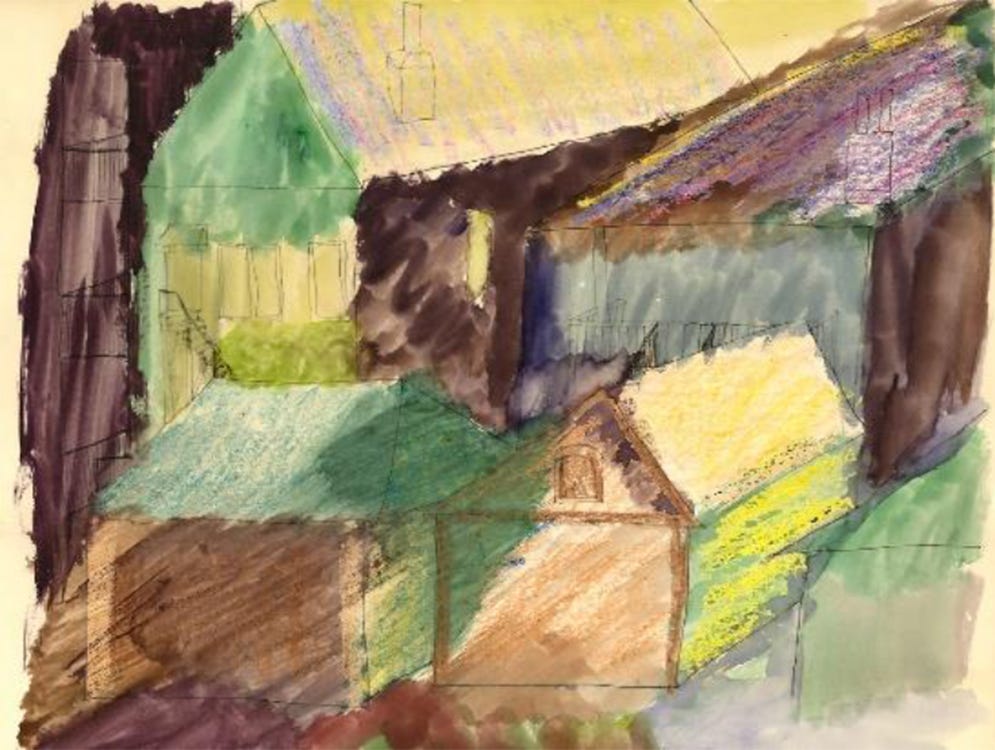
I am not an artist. I don’t pretend to be one. But the painting of the alley behind 1343 Wolfram, since demolished, is as I remember it. There would be dark corners and bright windows, green lawns, and the smell of dinner and the sound of a lawn sprinkler and then there would be that heavy blanket of snow and all the colors would leach out, leaving gray, brown, white, taupe—the other painting in my head. This one though is filled with nighttime and waning light, the angle of a porch light on the wooden stairs to the garage, and the smell of garbage cans, metallic and cold to the touch. And there I am, neither coming nor going, but here.